

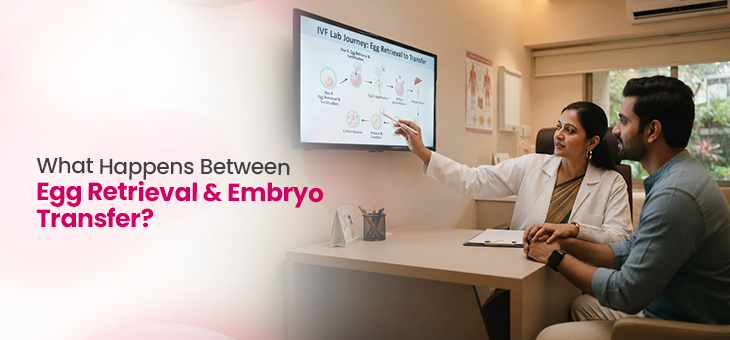
What Happens Between Egg Retrieval and Embryo Transfer?
Egg retrieval and embryo transfer are two important stages of an IVF cycle. However, several steps take place between them. After the eggs are collected, the fertility team works to fertilise the eggs, monitor embryo development and determine the appropriate time for transfer.
Understanding this stage can help couples know what to expect during their IVF journey.
What Happens Immediately After Egg Retrieval?
After egg retrieval, the collected eggs are taken to the laboratory for assessment. The fertility team evaluates the eggs and prepares them for fertilisation.
At the same time, the sperm sample is processed according to the treatment plan.
How Are the Eggs Fertilised?
Conventional Fertilisation
In some IVF cycles, prepared sperm is placed with the eggs in the laboratory to allow fertilisation to occur.
ICSI (Intracytoplasmic Sperm Injection)
When ICSI is recommended, an embryologist injects a single sperm directly into a mature egg.
The choice depends on the couple's individual circumstances and treatment plan.
What Happens After Fertilisation?
Once fertilisation occurs, the resulting embryos are monitored in the laboratory as they develop.
Embryo Development
Embryos are carefully observed for their development and progression over the following days.
Embryo Assessment
The fertility team assesses embryo development to help determine which embryo may be suitable for transfer according to the treatment plan.
Understanding Your IVF Journey
Every IVF cycle is planned according to individual circumstances and medical needs.
Book a ConsultationWhen Does Embryo Transfer Take Place?
The timing of embryo transfer depends on embryo development, the treatment plan and the patient's individual circumstances.
In some cycles, an embryo may be transferred during the same treatment cycle. In other situations, embryos may be frozen for transfer at a later time.
What Happens Before Embryo Transfer?
Before transfer, the fertility team reviews the treatment plan and prepares for the procedure.
The selected embryo is carefully prepared in the laboratory before being transferred into the uterus.
What Is Frozen Embryo Transfer?
A frozen embryo transfer involves using an embryo that was previously frozen and stored. The uterus is prepared for transfer according to the individual's treatment plan.
The timing and preparation can vary between patients.
FAQ
How many days after egg retrieval is embryo transfer?
The timing can vary depending on embryo development and the individual IVF treatment plan. Your fertility specialist will advise you about the appropriate timing.
Are all retrieved eggs fertilised?
No. Not every retrieved egg will necessarily fertilise or develop into an embryo.
What happens to embryos after fertilisation?
Embryos are monitored in the laboratory as they develop. Their progress is assessed before the next stage of treatment.
Is embryo transfer always done immediately after egg retrieval?
No. Depending on the circumstances, a fresh transfer or frozen embryo transfer may be considered.
Can embryos be frozen?
Yes. Suitable embryos may be frozen and stored for future use when recommended as part of the treatment plan.
Conclusion
Egg retrieval is followed by several important laboratory and clinical steps before embryo transfer. These include fertilisation, embryo development and assessment, followed by preparation for either fresh or frozen embryo transfer depending on the individual treatment plan.
If you are considering IVF treatment in Bangalore, understanding each stage can help you feel more prepared for the treatment journey.
Take the Next Step in Your IVF Journey
Book a Fertility Consultation at Cambridge Hospital